\(
\newenvironment {prompt}{}{}
\newcommand {\accordion }[0]{}
\newcommand {\ungraded }[0]{}
\newcommand {\xmDefaultPreamble }[0]{xmPreamble.tex}
\newcommand {\xmDefaultPrintstyle }[0]{xmPrintstyle.sty}
\newcommand {\todo }[0]{}
\newcommand {\oiint }[0]{{\large \bigcirc }\kern -1.56em\iint }
\newcommand {\mooculus }[0]{\textsf {\textbf {MOOC}\textnormal {\textsf {ULUS}}}}
\newcommand {\tkzTabSlope }[1]{\foreach \x /\y /\z in {#1}{\node [left = 3pt] at (Z\x 1) {\scriptsize $\y $}; \node [right = 3pt] at (Z\x 1) {\scriptsize $\z $}; }}
\newcommand {\RR }[0]{\mathbb R}
\newcommand {\R }[0]{\mathbb R}
\newcommand {\N }[0]{\mathbb N}
\newcommand {\Z }[0]{\mathbb Z}
\newcommand {\sagemath }[0]{\textsf {SageMath}}
\newcommand {\d }[0]{\,d}
\newcommand {\l }[0]{\ell }
\newcommand {\ddx }[0]{\frac {d}{\d x}}
\newcommand {\zeroOverZero }[0]{\ensuremath {\boldsymbol {\tfrac {0}{0}}}}
\newcommand {\inftyOverInfty }[0]{\ensuremath {\boldsymbol {\tfrac {\infty }{\infty }}}}
\newcommand {\zeroOverInfty }[0]{\ensuremath {\boldsymbol {\tfrac {0}{\infty }}}}
\newcommand {\zeroTimesInfty }[0]{\ensuremath {\small \boldsymbol {0\cdot \infty }}}
\newcommand {\inftyMinusInfty }[0]{\ensuremath {\small \boldsymbol {\infty - \infty }}}
\newcommand {\oneToInfty }[0]{\ensuremath {\boldsymbol {1^\infty }}}
\newcommand {\zeroToZero }[0]{\ensuremath {\boldsymbol {0^0}}}
\newcommand {\inftyToZero }[0]{\ensuremath {\boldsymbol {\infty ^0}}}
\newcommand {\numOverZero }[0]{\ensuremath {\boldsymbol {\tfrac {\#}{0}}}}
\newcommand {\dfn }[0]{\textbf }
\newcommand {\unit }[0]{\mathop {}\!\mathrm }
\newcommand {\eval }[1]{\bigg [ #1 \bigg ]}
\newcommand {\seq }[1]{\left ( #1 \right )}
\newcommand {\epsilon }[0]{\varepsilon }
\newcommand {\phi }[0]{\varphi }
\newcommand {\iff }[0]{\Leftrightarrow }
\DeclareMathOperator {\arccot }{arccot}
\DeclareMathOperator {\arcsec }{arcsec}
\DeclareMathOperator {\arccsc }{arccsc}
\DeclareMathOperator {\si }{Si}
\DeclareMathOperator {\scal }{scal}
\DeclareMathOperator {\sign }{sign}
\newcommand {\arrowvec }[1]{{\overset {\rightharpoonup }{#1}}}
\newcommand {\vec }[1]{{\overset {\boldsymbol {\rightharpoonup }}{\mathbf {#1}}}\hspace {0in}}
\newcommand {\point }[1]{\left (#1\right )}
\newcommand {\pt }[1]{\mathbf {#1}}
\newcommand {\Lim }[2]{\lim _{\point {#1} \to \point {#2}}}
\DeclareMathOperator {\proj }{\mathbf {proj}}
\newcommand {\veci }[0]{{\boldsymbol {\hat {\imath }}}}
\newcommand {\vecj }[0]{{\boldsymbol {\hat {\jmath }}}}
\newcommand {\veck }[0]{{\boldsymbol {\hat {k}}}}
\newcommand {\vecl }[0]{\vec {\boldsymbol {\l }}}
\newcommand {\uvec }[1]{\mathbf {\hat {#1}}}
\newcommand {\utan }[0]{\mathbf {\hat {t}}}
\newcommand {\unormal }[0]{\mathbf {\hat {n}}}
\newcommand {\ubinormal }[0]{\mathbf {\hat {b}}}
\newcommand {\dotp }[0]{\bullet }
\newcommand {\cross }[0]{\boldsymbol \times }
\newcommand {\grad }[0]{\boldsymbol \nabla }
\newcommand {\divergence }[0]{\grad \dotp }
\newcommand {\curl }[0]{\grad \cross }
\newcommand {\lto }[0]{\mathop {\longrightarrow \,}\limits }
\newcommand {\bar }[0]{\overline }
\newcommand {\surfaceColor }[0]{violet}
\newcommand {\surfaceColorTwo }[0]{redyellow}
\newcommand {\sliceColor }[0]{greenyellow}
\newcommand {\vector }[1]{\left \langle #1\right \rangle }
\newcommand {\sectionOutcomes }[0]{}
\newcommand {\VerbMathToks }[2]{\alteqtoks {\begin {#2} #1 \end {#2}}}
\newcommand {\DeclareMicrotypeVariants }[1]{}
\newcommand {\DeclareMicrotypeAlias }[2]{}
\newcommand {\LoadMicrotypeFile }[1]{}
\newcommand {\DeclareMicrotypeFilePrefix }[1]{}
\newcommand {\DeclareMicrotypeBabelHook }[2]{}
\newcommand {\microtypesetup }[1]{}
\newcommand {\microtypecontext }[1]{}
\newcommand {\textmicrotypecontext }[2]{#2}
\newcommand {\leftprotrusion }[1]{#1}
\newcommand {\rightprotrusion }[1]{#1}
\newcommand {\noprotrusionifhmode }[0]{}
\newcommand {\lsstyle }[0]{}
\newcommand {\lslig }[1]{#1}
\newcommand {\maketitle }[0]{}
\newcommand {\problem }[0]{ }
\newcommand {\exercise }[0]{ }
\newcommand {\question }[0]{ }
\newcommand {\exploration }[0]{ }
\newcommand {\dialogue }[0]{\begin {description}}
\newcommand {\GetTranslation }[1]{#1}
\)
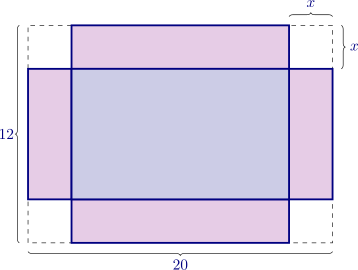
Uma caixa sem tampa deve ser construída a partir de um pedaço
retangular de papelão com dimensões \(12\unit {in}\) por \(20\unit {in}\), recortando quadrados iguais
de lado \(x\) em cada canto e depois dobrando as laterais para cima:
Expresse o volume
\(V\) da caixa como função de \(x\). \[ V(x) = \class{xm-answer}{\cssId{xm-answer-1}{\phantom{\rule{7em}{1.5em}}}} \]
Simplifique sua resposta acima: \[ V(x) = \class{xm-answer}{\cssId{xm-answer-2}{\phantom{\rule{7em}{1.5em}}}}x^3 + \class{xm-answer}{\cssId{xm-answer-3}{\phantom{\rule{7em}{1.5em}}}}x^2 + \class{xm-answer}{\cssId{xm-answer-4}{\phantom{\rule{7em}{1.5em}}}}x \]
Qual é o
domínio (natural) de \(V\)? \[ \left [\class{xm-answer}{\cssId{xm-answer-5}{\phantom{\rule{7em}{1.5em}}}},\class{xm-answer}{\cssId{xm-answer-6}{\phantom{\rule{7em}{1.5em}}}}\right ] \]
A função \(V\) é um polinômio?
sim não
\(V\) não é um
polinômio. O domínio de um polinômio é \((-\infty ,\infty )\). \(V\) é um polinômio em um domínio restrito.
Calcule (escreva um número ou “DNE”, de “Does Not Exist”, isto é, não
existe): \begin{align*} V(1) &= \class{xm-answer}{\cssId{xm-answer-7}{\phantom{\rule{7em}{1.5em}}}}\\ V(5) &= \class{xm-answer}{\cssId{xm-answer-8}{\phantom{\rule{7em}{1.5em}}}}\\ V(10) &= \class{xm-answer}{\cssId{xm-answer-9}{\phantom{\rule{7em}{1.5em}}}} \end{align*}
Se \(x = 1\) e aumenta em \(h\), quanto o volume da caixa vai variar? Simplifique.
xmhintVocê pode achar úteis as seguintes fórmulas de multiplicação de binômios:
\begin{align*} (a+b)^2 &= a^2 + 2ab + b^2\\ (a + b)^3 &= a^3 + 3 a^2 b + 3 ab^2 + b^3 \end{align*}
\[ V(1+h) - V(1) =4(1+h)^3 -64(1+h)^2 +240(1+h)-180=\class{xm-answer}{\cssId{xm-answer-10}{\phantom{\rule{7em}{1.5em}}}}h^3 +\class{xm-answer}{\cssId{xm-answer-11}{\phantom{\rule{7em}{1.5em}}}}h^2 + \class{xm-answer}{\cssId{xm-answer-12}{\phantom{\rule{7em}{1.5em}}}}h \] Quando \(x\) aumenta de \(x=1\) para \(x=5\), qual é o valor de \(h\)? \[ h=\class{xm-answer}{\cssId{xm-answer-13}{\phantom{\rule{7em}{1.5em}}}} \] Agora calcule \begin{align*} V(5) &= \class{xm-answer}{\cssId{xm-answer-14}{\phantom{\rule{7em}{1.5em}}}}\\ V(1) &= \class{xm-answer}{\cssId{xm-answer-15}{\phantom{\rule{7em}{1.5em}}}}\\ V(5) - V(1) &= \class{xm-answer}{\cssId{xm-answer-16}{\phantom{\rule{7em}{1.5em}}}} \end{align*}
Também sabemos, pelo seu trabalho acima, que \begin{align*} V(1+h) -V(1) &= 4h^3 -52h^2 + 124h\\ V(1+4) -V(1) &= 4(4)^3 -52(4)^2 + 124(4)\\ V(1+4) - V(1) &= \class{xm-answer}{\cssId{xm-answer-17}{\phantom{\rule{7em}{1.5em}}}} \end{align*}
Expresse a área total da superfície (incluindo AMBOS os lados, o de dentro e o de
fora) da caixa aberta como função de \(x\). \[ S(x) = 2\cdot \left [(20-2x)(12-2x)+2(12-2x)\cdot \left (\class{xm-answer}{\cssId{xm-answer-18}{\phantom{\rule{7em}{1.5em}}}}\right )+2x\cdot \left (\class{xm-answer}{\cssId{xm-answer-19}{\phantom{\rule{7em}{1.5em}}}}\right )\right ] \] Simplifique a expressão acima. \[ S(x) =480- \class{xm-answer}{\cssId{xm-answer-20}{\phantom{\rule{7em}{1.5em}}}} \]
Quando \(x\) aumenta de \(1\) para \((1+h)\), a área total da superfície da caixa varia em
\[ S(1+h) - S(1) = \class{xm-answer}{\cssId{xm-answer-21}{\phantom{\rule{7em}{1.5em}}}}h^2 + \class{xm-answer}{\cssId{xm-answer-22}{\phantom{\rule{7em}{1.5em}}}}h \] Portanto, quando \(x\) aumenta de \(1\) para \((1+h)\), a área da superfície diminui em
\(\class{xm-answer}{\cssId{xm-answer-23}{\phantom{\rule{7em}{1.5em}}}}\).
Como exercício final, ilustre essa variação em um desenho e compartilhe seu desenho com um colega.
Eu fiz isso. Eu não fiz isso.