\(0\) \(f(0)\) \(1\) \(f(0)\) não está definido é impossível dizer
\(
\newenvironment {prompt}{}{}
\newcommand {\accordion }[0]{}
\newcommand {\ungraded }[0]{}
\newcommand {\xmDefaultPreamble }[0]{xmPreamble.tex}
\newcommand {\xmDefaultPrintstyle }[0]{xmPrintstyle.sty}
\newcommand {\todo }[0]{}
\newcommand {\oiint }[0]{{\large \bigcirc }\kern -1.56em\iint }
\newcommand {\mooculus }[0]{\textsf {\textbf {MOOC}\textnormal {\textsf {ULUS}}}}
\newcommand {\tkzTabSlope }[1]{\foreach \x /\y /\z in {#1}{\node [left = 3pt] at (Z\x 1) {\scriptsize $\y $}; \node [right = 3pt] at (Z\x 1) {\scriptsize $\z $}; }}
\newcommand {\RR }[0]{\mathbb R}
\newcommand {\R }[0]{\mathbb R}
\newcommand {\N }[0]{\mathbb N}
\newcommand {\Z }[0]{\mathbb Z}
\newcommand {\sagemath }[0]{\textsf {SageMath}}
\newcommand {\d }[0]{\,d}
\newcommand {\l }[0]{\ell }
\newcommand {\ddx }[0]{\frac {d}{\d x}}
\newcommand {\zeroOverZero }[0]{\ensuremath {\boldsymbol {\tfrac {0}{0}}}}
\newcommand {\inftyOverInfty }[0]{\ensuremath {\boldsymbol {\tfrac {\infty }{\infty }}}}
\newcommand {\zeroOverInfty }[0]{\ensuremath {\boldsymbol {\tfrac {0}{\infty }}}}
\newcommand {\zeroTimesInfty }[0]{\ensuremath {\small \boldsymbol {0\cdot \infty }}}
\newcommand {\inftyMinusInfty }[0]{\ensuremath {\small \boldsymbol {\infty - \infty }}}
\newcommand {\oneToInfty }[0]{\ensuremath {\boldsymbol {1^\infty }}}
\newcommand {\zeroToZero }[0]{\ensuremath {\boldsymbol {0^0}}}
\newcommand {\inftyToZero }[0]{\ensuremath {\boldsymbol {\infty ^0}}}
\newcommand {\numOverZero }[0]{\ensuremath {\boldsymbol {\tfrac {\#}{0}}}}
\newcommand {\dfn }[0]{\textbf }
\newcommand {\unit }[0]{\mathop {}\!\mathrm }
\newcommand {\eval }[1]{\bigg [ #1 \bigg ]}
\newcommand {\seq }[1]{\left ( #1 \right )}
\newcommand {\epsilon }[0]{\varepsilon }
\newcommand {\phi }[0]{\varphi }
\newcommand {\iff }[0]{\Leftrightarrow }
\DeclareMathOperator {\arccot }{arccot}
\DeclareMathOperator {\arcsec }{arcsec}
\DeclareMathOperator {\arccsc }{arccsc}
\DeclareMathOperator {\si }{Si}
\DeclareMathOperator {\scal }{scal}
\DeclareMathOperator {\sign }{sign}
\newcommand {\arrowvec }[1]{{\overset {\rightharpoonup }{#1}}}
\newcommand {\vec }[1]{{\overset {\boldsymbol {\rightharpoonup }}{\mathbf {#1}}}\hspace {0in}}
\newcommand {\point }[1]{\left (#1\right )}
\newcommand {\pt }[1]{\mathbf {#1}}
\newcommand {\Lim }[2]{\lim _{\point {#1} \to \point {#2}}}
\DeclareMathOperator {\proj }{\mathbf {proj}}
\newcommand {\veci }[0]{{\boldsymbol {\hat {\imath }}}}
\newcommand {\vecj }[0]{{\boldsymbol {\hat {\jmath }}}}
\newcommand {\veck }[0]{{\boldsymbol {\hat {k}}}}
\newcommand {\vecl }[0]{\vec {\boldsymbol {\l }}}
\newcommand {\uvec }[1]{\mathbf {\hat {#1}}}
\newcommand {\utan }[0]{\mathbf {\hat {t}}}
\newcommand {\unormal }[0]{\mathbf {\hat {n}}}
\newcommand {\ubinormal }[0]{\mathbf {\hat {b}}}
\newcommand {\dotp }[0]{\bullet }
\newcommand {\cross }[0]{\boldsymbol \times }
\newcommand {\grad }[0]{\boldsymbol \nabla }
\newcommand {\divergence }[0]{\grad \dotp }
\newcommand {\curl }[0]{\grad \cross }
\newcommand {\lto }[0]{\mathop {\longrightarrow \,}\limits }
\newcommand {\bar }[0]{\overline }
\newcommand {\surfaceColor }[0]{violet}
\newcommand {\surfaceColorTwo }[0]{redyellow}
\newcommand {\sliceColor }[0]{greenyellow}
\newcommand {\vector }[1]{\left \langle #1\right \rangle }
\newcommand {\sectionOutcomes }[0]{}
\newcommand {\VerbMathToks }[2]{\alteqtoks {\begin {#2} #1 \end {#2}}}
\newcommand {\DeclareMicrotypeVariants }[1]{}
\newcommand {\DeclareMicrotypeAlias }[2]{}
\newcommand {\LoadMicrotypeFile }[1]{}
\newcommand {\DeclareMicrotypeFilePrefix }[1]{}
\newcommand {\DeclareMicrotypeBabelHook }[2]{}
\newcommand {\microtypesetup }[1]{}
\newcommand {\microtypecontext }[1]{}
\newcommand {\textmicrotypecontext }[2]{#2}
\newcommand {\leftprotrusion }[1]{#1}
\newcommand {\rightprotrusion }[1]{#1}
\newcommand {\noprotrusionifhmode }[0]{}
\newcommand {\lsstyle }[0]{}
\newcommand {\lslig }[1]{#1}
\newcommand {\maketitle }[0]{}
\newcommand {\problem }[0]{ }
\newcommand {\exercise }[0]{ }
\newcommand {\question }[0]{ }
\newcommand {\exploration }[0]{ }
\newcommand {\dialogue }[0]{\begin {description}}
\newcommand {\GetTranslation }[1]{#1}
\)
Apresentamos os limites.
1 A ideia básica
Considere a função \[ f(x) = \frac {\sin (x)}{x}. \] Embora \(f(x)\) não esteja definida em \(x=0\), ainda podemos traçar \(f(x)\) em outros valores próximos de \(x = 0\).
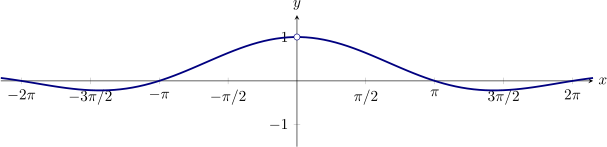
Use o gráfico de \(f(x) = \frac {\sin (x)}{x}\) acima para responder à pergunta a seguir: Quanto vale \(f(0)\)?
Mesmo assim, podemos ver que, à medida que \(x\) se aproxima de zero, \(f(x)\) se aproxima de um. É a partir dessa situação que chegamos à nossa definição de limite.
Intuitivamente,
o limite de \(f(x)\) quando \(x\) se aproxima de \(a\) é \(L\),
e escrevemos \[ \lim _{x\to a} f(x) = L, \] se o valor de \(f(x)\) fica tão próximo de \(L\) quanto se queira para todo \(x\) suficientemente próximo de \(a\), mas diferente dele.
Use o gráfico de \(f(x) = \frac {\sin (x)}{x}\) acima para completar a afirmação a seguir: “Um bom palpite é
que…”
\(\lim _{x\to 0}\frac {\sin (x)}{x} = 1\). \(\lim _{x\to 1}\frac {\sin (x)}{x} = 0\). \(\lim _{x\to 1}f(x) = \frac {\sin (1)}{1}\). \(\lim _{x\to 0}f(x) = \frac {\sin (0)}{0}=\infty \).
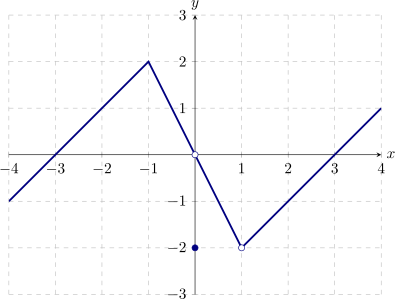
Considere o gráfico de \(y=f(x)\) a seguir
Use o gráfico
para calcular os valores a seguir. Escreva DNE se o valor não existir.
-
\(f(-2) \begin{prompt}=\class{xm-answer}{\cssId{xm-answer-1}{\phantom{\rule{7em}{1.5em}}}}\end{prompt}\)
-
\(\lim _{x\to -2}f(x)\begin{prompt}=\class{xm-answer}{\cssId{xm-answer-2}{\phantom{\rule{7em}{1.5em}}}}\end{prompt}\)
-
\(f(-1) \begin{prompt}=\class{xm-answer}{\cssId{xm-answer-3}{\phantom{\rule{7em}{1.5em}}}}\end{prompt}\)
-
\(\lim _{x\to -1}f(x) \begin{prompt}=\class{xm-answer}{\cssId{xm-answer-4}{\phantom{\rule{7em}{1.5em}}}}\end{prompt}\)
-
\(f(0) \begin{prompt}=\class{xm-answer}{\cssId{xm-answer-5}{\phantom{\rule{7em}{1.5em}}}}\end{prompt}\)
-
\(\lim _{x\to 0} f(x) \begin{prompt}=\class{xm-answer}{\cssId{xm-answer-6}{\phantom{\rule{7em}{1.5em}}}}\end{prompt}\)
-
\(f(1) \begin{prompt}=\class{xm-answer}{\cssId{xm-answer-7}{\phantom{\rule{7em}{1.5em}}}}\end{prompt}\)
-
\(\lim _{x\to 1} f(x) \begin{prompt}=\class{xm-answer}{\cssId{xm-answer-8}{\phantom{\rule{7em}{1.5em}}}}\end{prompt}\)
2 Limites podem não existir
Limites podem não existir. Vamos ver como isso acontece.
Considere o gráfico de \(f(x) = \lfloor x\rfloor \). 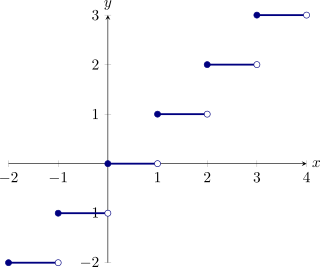 Explique por que o limite \[ \lim _{x\to 2} f(x) \] não existe.
A função \(\lfloor x \rfloor \) é a função que retorna o maior
inteiro menor ou igual a \(x\). Lembre-se de que \[ \lim _{x\to 2} \lfloor x \rfloor = L \] se \(\lfloor x\rfloor \) pode ficar arbitrariamente próximo
de \(L\) tomando \(x\) suficientemente próximo de \(2\), mas diferente dele. Então vamos
examinar \(x\) próximo de \(2\), mas diferente dele. Agora a pergunta é: Quanto vale
\(L\)?
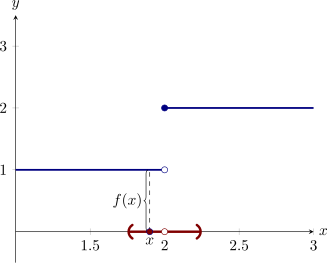 Se
olharmos o que acontece para valores de \(x\) cada vez mais próximos de \(x=2\), mas
ficando à esquerda de 2, vemos que \(f(x) = 1\). No entanto, se deixarmos os valores de \(x\)
ficarem cada vez mais próximos de \(x=2\), mas ficando à direita de 2, vemos
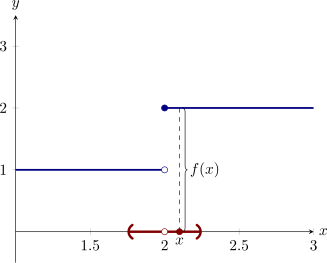 Isto é, para valores de \(x\)
próximos de \(2\), mas maiores que \(2\), \(f(x)=2\). Não conseguimos encontrar um único número do
qual \(f(x)\) se aproxime quando \(x\) se aproxima de 2, e por isso o limite não existe.
Se esse limite existe, então deveríamos conseguir olhar suficientemente perto de \(x=2\), mas não exatamente nesse ponto, e ver que \(f\) se aproxima de algum número. Vamos olhar um gráfico:
Tabelas podem ajudar a fazer palpites sobre valores de limites, mas é preciso ter cuidado.
Considere \(f(x) = \sin \left (\frac {\pi }{x}\right )\). Preencha as tabelas abaixo arredondando para três casas
decimais: \[ \begin{array}{l|l} x & f(x) \\ \hline 0.1 & \begin{prompt}\class{xm-answer}{\cssId{xm-answer-9}{\phantom{\rule{7em}{1.5em}}}}\end{prompt}\\ 0.01 & \begin{prompt}\class{xm-answer}{\cssId{xm-answer-10}{\phantom{\rule{7em}{1.5em}}}}\end{prompt}\\ 0.001 & \begin{prompt}\class{xm-answer}{\cssId{xm-answer-11}{\phantom{\rule{7em}{1.5em}}}}\end{prompt}\\ 0.0001 & \begin{prompt}\class{xm-answer}{\cssId{xm-answer-12}{\phantom{\rule{7em}{1.5em}}}}\end{prompt}\\ \end{array} \] Podemos nos apressar e dizer que, com base na tabela acima, \[ \lim _{x\to 0}\sin \left (\frac {\pi }{x}\right )=0. \] Mas
lembre-se da definição de limite: \(L\) é o limite se o valor de \(f(x)\) fica tão próximo de \(L\)
quanto se queira para todo \(x\) suficientemente próximo de \(a\), mas diferente
dele.
A partir dessa tabela, podemos ver que \(f(x)(=0)\) fica tão próximo de \(L(=0)\) quanto se queira para alguns valores de \(x\) suficientemente próximos de \(a(=0)\). Mas isso não satisfaz a definição de limite, pelo menos, ainda não.
Mas, espere! Preencha outra tabela, arredondando para três casas decimais. \[ \begin{array}{l|l} x & f(x) \\ \hline 0.3 & \begin{prompt}\class{xm-answer}{\cssId{xm-answer-13}{\phantom{\rule{7em}{1.5em}}}}\end{prompt} \\ 0.03 & \begin{prompt}\class{xm-answer}{\cssId{xm-answer-14}{\phantom{\rule{7em}{1.5em}}}}\end{prompt} \\ 0.003 & \begin{prompt}\class{xm-answer}{\cssId{xm-answer-15}{\phantom{\rule{7em}{1.5em}}}}\end{prompt} \\ 0.0003 & \begin{prompt}\class{xm-answer}{\cssId{xm-answer-16}{\phantom{\rule{7em}{1.5em}}}}\end{prompt} \end{array} \] O que essas duas tabelas nos dizem sobre \[ \lim _{x\to 0}\sin \left (\frac {\pi }{x}\right )? \]
\(\lim _{x\to 0}\sin \left (\frac {\pi }{x}\right ) = 0\) \(\lim _{x\to 0}\sin \left (\frac {\pi }{x}\right )=1\) \(\lim _{x\to 0}\sin \left (\frac {\pi }{x}\right ) = -.866\) \(\lim _{x\to 0}\sin \left (\frac {\pi }{x}\right ) = -.433\) O limite não existe.
O limite
não existe. A primeira tabela mostra que sempre podemos encontrar um valor de \(x\) tão
próximo de \(0\) quanto quisermos tal que \(f(x)=0\). No entanto, o limite não é igual a \(0\), pois a
segunda tabela mostra que também podemos encontrar um valor de \(x\) tão próximo de \(0\)
quanto quisermos tal que \(f(x)=-\frac {\sqrt {3}}{2}\). Na verdade, para qualquer número \(y\), \(-1\le y\le 1\), podemos encontrar
um valor de \(x\) tão próximo de \(0\) quanto quisermos tal que \(f(x)=y\). Confira o gráfico da função \(f\).
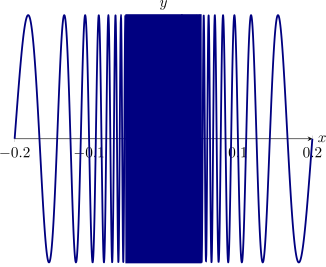 Vemos que \(f(x)\) oscila
“descontroladamente” quando \(x\) se aproxima de \(0\) e, portanto, não se aproxima de
nenhum número em particular.
3 Limites laterais
Embora tenhamos visto que \(\lim _{x\to 2}\lfloor x\rfloor \) não existe, seu gráfico parece bem mais “comportado” perto de \(a=2\) do que o gráfico anterior perto de \(a=0\). Há mais a dizer sobre a função \(\lfloor x\rfloor \) e seu comportamento perto de \(a=2\).
Intuitivamente,
para a função \(f\), \(L\) é o limite à direita quando \(x\) se aproxima de \(a\),
e escrevemos \[ \lim _{x\to a^+} f(x) = L, \] se o valor de \(f(x)\) fica tão próximo de \(L\) quanto se queira para todo \(x>a\) suficientemente próximo de \(a\).
Analogamente,
para a função \(f\), \(L\) é o limite à esquerda quando \(x\) se aproxima de \(a\),
e escrevemos \[ \lim _{x\to a^-} f(x) = L, \] se o valor de \(f(x)\) fica tão próximo de \(L\) quanto se queira para todo \(x<a\) suficientemente próximo de \(a\).
Calcule: \[ \lim _{x\to 2^-} f(x)\qquad \text {e}\qquad \lim _{x\to 2^+} f(x) \] usando o gráfico abaixo 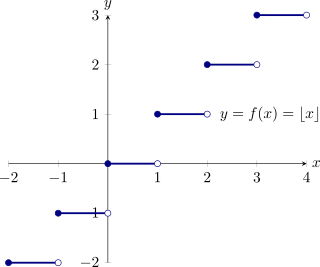
Pelo gráfico, podemos ver que, à medida que \(x\) se aproxima de \(2\) pela esquerda, \(\lfloor x\rfloor \)
permanece em \(y=1\) até exatamente o ponto em que \(x=2\). Logo, \[ \lim _{x\to 2^-} f(x)=1. \] Também pelo gráfico,
podemos ver que, à medida que \(x\) se aproxima de \(2\) pela direita, \(\lfloor x\rfloor \) permanece em \(y=2\) até \(x=2\).
Logo, \[ \lim _{x\to 2^+} f(x)=2. \]
4 Juntando tudo isso
Os limites laterais nos ajudam a falar sobre limites.
Um limite \[ \lim _{x \to a} f(x) \] existe se, e somente
se,
-
\(\lim _{x \to a^-} f(x)\) existe
-
\(\lim _{x \to a^+} f(x)\) existe
-
\(\lim _{x \to a^-} f(x) = \lim _{x \to a^+} f(x)\)
Nesse caso, \(\lim _{x \to a} f(x)\) é igual ao valor comum dos dois limites laterais.
Calcule as expressões a seguir consultando o gráfico abaixo. Escreva DNE se
o limite não existir. 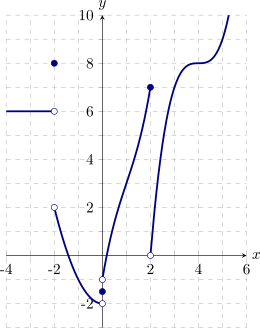
-
\(\lim _{x\to 4} f(x) \begin{prompt}=\class{xm-answer}{\cssId{xm-answer-17}{\phantom{\rule{7em}{1.5em}}}}\end{prompt}\)
-
\(\lim _{x\to -3} f(x)\begin{prompt}=\class{xm-answer}{\cssId{xm-answer-18}{\phantom{\rule{7em}{1.5em}}}}\end{prompt}\)
-
\(\lim _{x\to -3^-} f(x) \begin{prompt}=\class{xm-answer}{\cssId{xm-answer-19}{\phantom{\rule{7em}{1.5em}}}}\end{prompt}\)
-
\(\lim _{x\to 0} f(x) \begin{prompt}=\class{xm-answer}{\cssId{xm-answer-20}{\phantom{\rule{7em}{1.5em}}}}\end{prompt}\)
-
\(\lim _{x\to 0^-} f(x) \begin{prompt}=\class{xm-answer}{\cssId{xm-answer-21}{\phantom{\rule{7em}{1.5em}}}}\end{prompt}\)
-
\(\lim _{x\to 0^+} f(x) \begin{prompt}=\class{xm-answer}{\cssId{xm-answer-22}{\phantom{\rule{7em}{1.5em}}}}\end{prompt}\)
-
\(f(0) \begin{prompt}=\class{xm-answer}{\cssId{xm-answer-23}{\phantom{\rule{7em}{1.5em}}}}\end{prompt}\)
-
\(f(-2) \begin{prompt}=\class{xm-answer}{\cssId{xm-answer-24}{\phantom{\rule{7em}{1.5em}}}}\end{prompt}\)
-
\(\lim _{x\to -2^+} f(x) \begin{prompt}=\class{xm-answer}{\cssId{xm-answer-25}{\phantom{\rule{7em}{1.5em}}}}\end{prompt}\)
-
\(\lim _{x\to -2^-} f(x) \begin{prompt}=\class{xm-answer}{\cssId{xm-answer-26}{\phantom{\rule{7em}{1.5em}}}}\end{prompt}\)
-
\(\lim _{x\to 2^-} f(x) \begin{prompt}=\class{xm-answer}{\cssId{xm-answer-27}{\phantom{\rule{7em}{1.5em}}}}\end{prompt}\)
-
\(\lim _{x\to 1} f(x) \begin{prompt}=\class{xm-answer}{\cssId{xm-answer-28}{\phantom{\rule{7em}{1.5em}}}}\end{prompt}\)