Queremos calcular limites aos quais as leis dos limites não se aplicam.
Na seção anterior calculamos limites usando continuidade e as leis dos limites. E os
limites que não podem ser calculados diretamente por esses métodos? Considere o
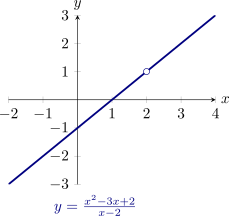
seguinte limite, \[ \lim _{x\to 2}\frac {x^2-3x+2}{x-2}. \] Aqui \[ \lim _{x\to 2}\left (x^2-3x+2\right ) = 0\qquad \text {e}\qquad \lim _{x\to 2}\left (x-2\right ) = 0 \] diante disso, você pode pensar que o limite é um ou zero.
Calma lá. Esse limite é de uma forma indeterminada. O que isso quer dizer?
Continue lendo, jovem matemático.
Dizemos que um limite \[ \lim _{x\to a} \frac {f(x)}{g(x)} \] é da forma \(\relax \boldsymbol {\tfrac {0}{0}}\) se \[ \lim _{x\to a} f(x) = 0\quad \text {e}\quad \lim _{x\to a} g(x) =0. \]
Quais dos limites a seguir são da forma \(\relax \boldsymbol {\tfrac {0}{0}}\)?
O símbolo \(\relax \boldsymbol {\tfrac {0}{0}}\) não é o número \(0\) dividido por \(0\). É apenas uma notação abreviada. Ele
significa que o limite \(\lim _{x\to a} \frac {f(x)}{g(x)}\) tem a propriedade de que \[ \lim _{x\to a} f(x) = 0\quad \text {e}\quad \lim _{x\to a} g(x) =0. \] Ao escrever a forma de um limite,
NUNCA escrevemos \(\lim _{x \to a}\dfrac {f(x)}{g(x)}=\frac {0}{0}\). É o \(=\) que torna essa afirmação matematicamente incorreta. Em
vez disso, escreva: \(\lim _{x \to a}\dfrac {f(x)}{g(x)}\) é da forma \(\frac {0}{0}\)
Para encontrar a forma de \(\lim _{x \to a}\dfrac {f(x)}{g(x)}\), calcule os limites do numerador e do denominador
SEPARADAMENTE. Não basta “substituir \(x=a\)”. “Substituir” só pode ser feito depois
que se percebe que a função é contínua.
Para encontrar a forma, observe que \(\lim _{x\to 2}(x^2-3x+2)=0\) e \(\lim _{x\to 2}(x-2)=0\). Isso significa que nosso
limite tem a forma \(\relax \boldsymbol {\tfrac {0}{0}}\). No entanto, note que, se supusermos \(x\ne 2\), podemos escrever
\[ \frac {x^2-3x+2}{x-2} = \frac {(x-2)(\class{xm-given}{x-1})}{(x-2)} = \class{xm-given}{x-1}. \]
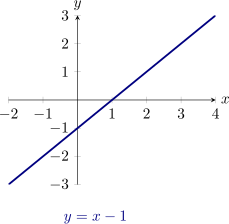
Assim, “nossa função” é igual ao polinômio \(x-1\) em todo lugar, exceto em \(x=2\). Portanto,
para todos os valores de \(x\) próximos de \(2\), “nossa função” é igual ao polinômio \(x-1\)!
Isso significa que \[ \lim _{x\to 2}\frac {x^2-3x+2}{x-2} = \lim _{x\to 2} (x-1). \] Mas agora precisamos calcular o limite de um polinômio,
\(\lim _{x\to 2} (x-1) =\class{xm-given}{1}\).
Logo \[ \lim _{x\to 2}\frac {x^2-3x+2}{x-2} = \class{xm-given}{1}. \]
Vamos considerar mais alguns exemplos da forma \(\relax \boldsymbol {\tfrac {0}{0}}\).
Primeiro, observe que \[ \lim _{x\to 1}\left (x-1\right )=0 \quad \text {e}\quad \lim _{x\to 1}\left (x^2+2x-3\right ) = 0. \] Logo, esse limite é da forma \(\relax \boldsymbol {\tfrac {0}{0}}\). Novamente, não
podemos aplicar a lei do quociente nem qualquer outra lei dos limites. Também não
podemos usar continuidade. Afinal, “nossa função” não é contínua em \(x=1\), pois não
está definida em \(x=1\).
O que pode ser feito? Podemos tentar cancelar um fator que tende a \(0\) no numerador e
no denominador. Como \(\class{xm-given}{(x-1)}\) é um fator que tende a \(0\) no numerador, vamos ver se
conseguimos fatorar um \(\class{xm-given}{(x-1)}\) no denominador também. \begin{align*} \lim _{x\to 1}\frac {x-1}{x^2+2x-3}&=\lim _{x\to 1}\frac {\cancel {x-1}}{\cancel {(x-1)}\class{xm-given}{(x+3)}} \\ &=\lim _{x\to 1}\frac {1}{\class{xm-given}{x+3}}\\ &=\frac {1}{4}. \end{align*}
Encontramos a forma desse limite olhando separadamente para os limites
do numerador e do denominador. O limite do numerador é: \begin{align*} \lim _{x\to 1}\left (\frac {1}{x+1}-\frac {3}{x+5}\right )&= \lim _{x\to 1}\frac {x+5-3(x+1)}{(x+1)(x+5)}\\ &= \lim _{x\to 1}\frac {-2x+2}{(x+1)(x+5)}\\ &= \frac {0}{12}\\ &=0 \end{align*}
O limite do denominador é: \[ \lim _{x\to 1}\left (x-1\right )=0 \] Nosso limite é, portanto, da forma \(\relax \boldsymbol {\tfrac {0}{0}}\) e provavelmente
podemos fatorar um termo que tende a \(0\) tanto no numerador quanto no denominador.
\[ \lim _{x\to 1} \frac {\frac {1}{x+1}-\frac {3}{x+5}}{x-1} \] Olhando para o denominador, esperamos que esse termo seja \((x-1)\). Infelizmente, não é
imediatamente óbvio como fatorar um \((x-1)\) no numerador. Então, devemos primeiro
simplificar a fração composta multiplicando-a por \[ 1 = \frac {(x+1)(x+5)}{(x+1)(x+5)} \] isso nos permitirá cancelar
imediatamente \begin{align*} \lim _{x\to 1}& \frac {\frac {1}{x+1}-\frac {3}{x+5}}{x-1} \cdot \frac {(x+1)(x+5)}{(x+1)(x+5)} \\ &= \lim _{x\to 1}\frac {(x+5)-3(x+1)}{(x+1)(x+5)(x-1)}. \end{align*}
Agora vamos expandir o numerador. Observe que não queremos expandir o
denominador, porque já temos um \((x-1)\) fatorado no denominador, e esse era o objetivo. \[ \lim _{x\to 1}\frac {(x+5)-3(x+1)}{(x+1)(x+5)(x-1)} \]
\begin{align*} &= \lim _{x\to 1}\frac {x+5-3x-3}{(x+1)(x+5)(x-1)} \\ &= \lim _{x\to 1}\frac {-2x+2}{(x+1)(x+5)(x-1)}\\ &= \lim _{x\to 1}\frac {-2\cancel {(x-1)}}{(x+1)(x+5)\cancel {(x-1)}}\\ &= \lim _{x\to 1}\frac {-2}{(x+1)(x+5)}. \end{align*}
Agora podemos ver que o limite de “nossa função” é igual ao limite de uma função
racional \(\frac {-2}{(x+1)(x+5)}\). Essa função racional é contínua em seu domínio e, portanto, em \(x=1\). Logo
\begin{align*} \lim _{x\to 1} \frac {\frac {1}{x+1}-\frac {3}{x+5}}{x-1}&=\lim _{x\to 1}\frac {-2}{(x+1)(x+5)}\\ &= \frac {-2}{(1+1)(1+5)} \\ &=\class{xm-given}{\frac {-1}{6}}. \end{align*}
Observe que \[ \lim _{x\to -1} \left (\sqrt {x+5}-2\right )=0\quad \text {e}\quad \lim _{x\to -1} \left (x+1\right ) =0. \] Nosso limite é, novamente, da forma \(\relax \boldsymbol {\tfrac {0}{0}}\) e provavelmente podemos fatorar
um termo que tende a \(0\) tanto no numerador quanto no denominador. Olhando para o
denominador, suspeitamos que esse termo seja \((x+1)\). Infelizmente, não é imediatamente
óbvio como fatorar um \((x+1)\) no numerador.
Vamos usar uma técnica algébrica chamada multiplicação pelo conjugado. Essa
técnica é útil quando você está tentando simplificar uma expressão que se parece
com \[ \sqrt {\text {algo}} \pm \text {outra coisa}. \] Ela tira proveito da regra da diferença de quadrados \[ a^2-b^2=(a-b)(a+b). \] No nosso caso, usaremos \(a=\sqrt {x+5}\)
e \(b=2\). Escreva \[ \lim _{x\to -1} \frac {\sqrt {x+5}-2}{x+1} \] \begin{align*} &= \lim _{x\to -1} \frac {\left (\sqrt {x+5}-2\right )}{(x+1)} \cdot \frac {\left (\sqrt {x+5}+2\right )}{\left (\sqrt {x+5}+2\right )} \\ &=\lim _{x\to -1} \frac {\class{xm-given}{\left (\sqrt {x+5}\right )^2-2^2}}{(x+1)\left (\sqrt {x+5}+2\right )} \\ &=\lim _{x\to -1} \frac {x+5-4}{(x+1)\left (\sqrt {x+5}+2\right )} \\ &=\lim _{x\to -1} \frac {\cancel {(x+1)}}{\cancel {(x+1)}\left (\sqrt {x+5}+2\right )} \\ &=\lim _{x\to -1} \frac {1}{\sqrt {x+5}+2}\\ &= \frac {1}{\sqrt {-1+5}+2}\\ &=\class{xm-given}{\frac {1}{4}}. \end{align*}
Todos os exemplos desta seção são limites da forma \(\relax \boldsymbol {\tfrac {0}{0}}\). Quando você encontrar um
limite da forma \(\relax \boldsymbol {\tfrac {0}{0}}\), deve tentar usar técnicas algébricas para chegar a uma função
contínua cujo limite você consiga calcular.
Observe que resolvemos vários exemplos de limites da forma \(\relax \boldsymbol {\tfrac {0}{0}}\) e obtivemos
respostas diferentes em cada um. Isso nos mostra que saber apenas que a forma
do limite é \(\relax \boldsymbol {\tfrac {0}{0}}\) não é suficiente para calcular o limite. A moral da história é
Limites da forma \(\relax \boldsymbol {\tfrac {0}{0}}\) podem assumir qualquer valor.
Uma forma que não nos dá nenhuma informação sobre se o limite existe ou não e,
caso o limite exista, nenhuma informação sobre o valor do limite, é chamada de
forma indeterminada.
Uma forma que dá informação sobre se o limite existe ou não e, caso exista, dá
informação sobre o valor do limite, é chamada de forma determinada.
Por fim, talvez você fique incomodado por termos introduzido uma forma, a saber \(\relax \boldsymbol {\tfrac {0}{0}}\),
só para acabar dizendo que ela não dá nenhuma informação sobre o valor do limite.
Mas é exatamente isso que torna as formas indeterminadas interessantes… elas são
um mistério!