Pelo gráfico, parece que a função \(f\) é crescente no intervalo \[ \left (\class{xm-given}{-\infty },\class{xm-given}{\infty }\right ) \]
\(
\newenvironment {prompt}{}{}
\newcommand {\accordion }[0]{}
\newcommand {\ungraded }[0]{}
\newcommand {\xmDefaultPreamble }[0]{xmPreamble.tex}
\newcommand {\xmDefaultPrintstyle }[0]{xmPrintstyle.sty}
\newcommand {\todo }[0]{}
\newcommand {\oiint }[0]{{\large \bigcirc }\kern -1.56em\iint }
\newcommand {\mooculus }[0]{\textsf {\textbf {MOOC}\textnormal {\textsf {ULUS}}}}
\newcommand {\tkzTabSlope }[1]{\foreach \x /\y /\z in {#1}{\node [left = 3pt] at (Z\x 1) {\scriptsize $\y $}; \node [right = 3pt] at (Z\x 1) {\scriptsize $\z $}; }}
\newcommand {\RR }[0]{\mathbb R}
\newcommand {\R }[0]{\mathbb R}
\newcommand {\N }[0]{\mathbb N}
\newcommand {\Z }[0]{\mathbb Z}
\newcommand {\sagemath }[0]{\textsf {SageMath}}
\newcommand {\d }[0]{\,d}
\newcommand {\l }[0]{\ell }
\newcommand {\ddx }[0]{\frac {d}{\d x}}
\newcommand {\zeroOverZero }[0]{\ensuremath {\boldsymbol {\tfrac {0}{0}}}}
\newcommand {\inftyOverInfty }[0]{\ensuremath {\boldsymbol {\tfrac {\infty }{\infty }}}}
\newcommand {\zeroOverInfty }[0]{\ensuremath {\boldsymbol {\tfrac {0}{\infty }}}}
\newcommand {\zeroTimesInfty }[0]{\ensuremath {\small \boldsymbol {0\cdot \infty }}}
\newcommand {\inftyMinusInfty }[0]{\ensuremath {\small \boldsymbol {\infty - \infty }}}
\newcommand {\oneToInfty }[0]{\ensuremath {\boldsymbol {1^\infty }}}
\newcommand {\zeroToZero }[0]{\ensuremath {\boldsymbol {0^0}}}
\newcommand {\inftyToZero }[0]{\ensuremath {\boldsymbol {\infty ^0}}}
\newcommand {\numOverZero }[0]{\ensuremath {\boldsymbol {\tfrac {\#}{0}}}}
\newcommand {\dfn }[0]{\textbf }
\newcommand {\unit }[0]{\mathop {}\!\mathrm }
\newcommand {\eval }[1]{\bigg [ #1 \bigg ]}
\newcommand {\seq }[1]{\left ( #1 \right )}
\newcommand {\epsilon }[0]{\varepsilon }
\newcommand {\phi }[0]{\varphi }
\newcommand {\iff }[0]{\Leftrightarrow }
\DeclareMathOperator {\arccot }{arccot}
\DeclareMathOperator {\arcsec }{arcsec}
\DeclareMathOperator {\arccsc }{arccsc}
\DeclareMathOperator {\si }{Si}
\DeclareMathOperator {\scal }{scal}
\DeclareMathOperator {\sign }{sign}
\newcommand {\arrowvec }[1]{{\overset {\rightharpoonup }{#1}}}
\newcommand {\vec }[1]{{\overset {\boldsymbol {\rightharpoonup }}{\mathbf {#1}}}\hspace {0in}}
\newcommand {\point }[1]{\left (#1\right )}
\newcommand {\pt }[1]{\mathbf {#1}}
\newcommand {\Lim }[2]{\lim _{\point {#1} \to \point {#2}}}
\DeclareMathOperator {\proj }{\mathbf {proj}}
\newcommand {\veci }[0]{{\boldsymbol {\hat {\imath }}}}
\newcommand {\vecj }[0]{{\boldsymbol {\hat {\jmath }}}}
\newcommand {\veck }[0]{{\boldsymbol {\hat {k}}}}
\newcommand {\vecl }[0]{\vec {\boldsymbol {\l }}}
\newcommand {\uvec }[1]{\mathbf {\hat {#1}}}
\newcommand {\utan }[0]{\mathbf {\hat {t}}}
\newcommand {\unormal }[0]{\mathbf {\hat {n}}}
\newcommand {\ubinormal }[0]{\mathbf {\hat {b}}}
\newcommand {\dotp }[0]{\bullet }
\newcommand {\cross }[0]{\boldsymbol \times }
\newcommand {\grad }[0]{\boldsymbol \nabla }
\newcommand {\divergence }[0]{\grad \dotp }
\newcommand {\curl }[0]{\grad \cross }
\newcommand {\lto }[0]{\mathop {\longrightarrow \,}\limits }
\newcommand {\bar }[0]{\overline }
\newcommand {\surfaceColor }[0]{violet}
\newcommand {\surfaceColorTwo }[0]{redyellow}
\newcommand {\sliceColor }[0]{greenyellow}
\newcommand {\vector }[1]{\left \langle #1\right \rangle }
\newcommand {\sectionOutcomes }[0]{}
\newcommand {\VerbMathToks }[2]{\alteqtoks {\begin {#2} #1 \end {#2}}}
\newcommand {\DeclareMicrotypeVariants }[1]{}
\newcommand {\DeclareMicrotypeAlias }[2]{}
\newcommand {\LoadMicrotypeFile }[1]{}
\newcommand {\DeclareMicrotypeFilePrefix }[1]{}
\newcommand {\DeclareMicrotypeBabelHook }[2]{}
\newcommand {\microtypesetup }[1]{}
\newcommand {\microtypecontext }[1]{}
\newcommand {\textmicrotypecontext }[2]{#2}
\newcommand {\leftprotrusion }[1]{#1}
\newcommand {\rightprotrusion }[1]{#1}
\newcommand {\noprotrusionifhmode }[0]{}
\newcommand {\lsstyle }[0]{}
\newcommand {\lslig }[1]{#1}
\newcommand {\maketitle }[0]{}
\newcommand {\problem }[0]{ }
\newcommand {\exercise }[0]{ }
\newcommand {\question }[0]{ }
\newcommand {\exploration }[0]{ }
\newcommand {\dialogue }[0]{\begin {description}}
\newcommand {\GetTranslation }[1]{#1}
\)
Dois jovens matemáticos discutem a derivada de funções inversas.
Confira este diálogo entre dois estudantes de cálculo (baseado em uma história real):
- Devyn
- Riley, tenho uma pergunta de cálculo.
- Riley
- Manda.
- Devyn
- Qual é a derivada de \(\arctan (x)\)?
- Riley
- Hmmm…ainda não falamos sobre isso na nossa aula.
- Devyn
- Eu sei! Mas talvez a gente consiga descobrir.
- Riley
- Bem, \[ \arctan (x) = \tan ^{-1}(x) \] e agora podemos usar a regra da cadeia para calcular a derivada \begin{align*} \ddx \tan ^{-1}(x) &= -\tan ^{-2}(x)\sec ^2(x)\\ &= -\frac {\cos ^2x}{\sin ^2x}\cdot \frac {1}{\cos ^2x}\\ &= \frac {-1}{\sin ^2x}\\ &= -\csc ^2x \end{align*}
- Devyn
- Mas isso está certo?
Vamos ver se conseguimos descobrir se Devyn e Riley estão certos. Comece olhando para um gráfico de \(\theta = \arctan (x)\):
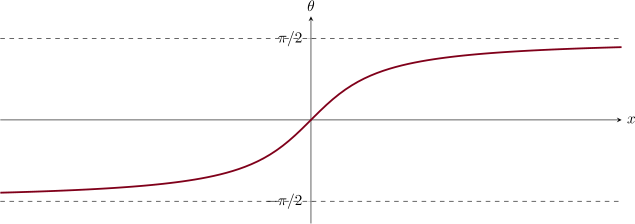
Seja \(f(x) = \arctan (x)\). Use o gráfico para determinar o(s) intervalo(s) em que a função \(f\) é
crescente.
Por outro lado,
Qual é o sinal de \(f'(x)= - \csc ^2 (x)\) no intervalo \((0,\pi )\)?
positivo negativo
Complete a frase abaixo:
Como o sinal de \(f'(x)= - \csc ^2 (x)\) no intervalo \((0,\pi )\) é
positivo negativo
a função \(f\) deve ser crescente
no intervalo \((0, \pi )\) decrescente no intervalo \((0, \pi )\)
À luz dos problemas acima, é possível que \[ \ddx \arctan (x) = -\csc ^2(x)? \]
sim não
Quando nossos amigos escreveram \(\arctan (x) = \tan ^{-1}(x)\), o que eles acham que o “\(-1\)” representa? Eles
estão certos?