\(
\newenvironment {prompt}{}{}
\newcommand {\accordion }[0]{}
\newcommand {\ungraded }[0]{}
\newcommand {\xmDefaultPreamble }[0]{xmPreamble.tex}
\newcommand {\xmDefaultPrintstyle }[0]{xmPrintstyle.sty}
\newcommand {\todo }[0]{}
\newcommand {\oiint }[0]{{\large \bigcirc }\kern -1.56em\iint }
\newcommand {\mooculus }[0]{\textsf {\textbf {MOOC}\textnormal {\textsf {ULUS}}}}
\newcommand {\tkzTabSlope }[1]{\foreach \x /\y /\z in {#1}{\node [left = 3pt] at (Z\x 1) {\scriptsize $\y $}; \node [right = 3pt] at (Z\x 1) {\scriptsize $\z $}; }}
\newcommand {\RR }[0]{\mathbb R}
\newcommand {\R }[0]{\mathbb R}
\newcommand {\N }[0]{\mathbb N}
\newcommand {\Z }[0]{\mathbb Z}
\newcommand {\sagemath }[0]{\textsf {SageMath}}
\newcommand {\d }[0]{\,d}
\newcommand {\l }[0]{\ell }
\newcommand {\ddx }[0]{\frac {d}{\d x}}
\newcommand {\zeroOverZero }[0]{\ensuremath {\boldsymbol {\tfrac {0}{0}}}}
\newcommand {\inftyOverInfty }[0]{\ensuremath {\boldsymbol {\tfrac {\infty }{\infty }}}}
\newcommand {\zeroOverInfty }[0]{\ensuremath {\boldsymbol {\tfrac {0}{\infty }}}}
\newcommand {\zeroTimesInfty }[0]{\ensuremath {\small \boldsymbol {0\cdot \infty }}}
\newcommand {\inftyMinusInfty }[0]{\ensuremath {\small \boldsymbol {\infty - \infty }}}
\newcommand {\oneToInfty }[0]{\ensuremath {\boldsymbol {1^\infty }}}
\newcommand {\zeroToZero }[0]{\ensuremath {\boldsymbol {0^0}}}
\newcommand {\inftyToZero }[0]{\ensuremath {\boldsymbol {\infty ^0}}}
\newcommand {\numOverZero }[0]{\ensuremath {\boldsymbol {\tfrac {\#}{0}}}}
\newcommand {\dfn }[0]{\textbf }
\newcommand {\unit }[0]{\mathop {}\!\mathrm }
\newcommand {\eval }[1]{\bigg [ #1 \bigg ]}
\newcommand {\seq }[1]{\left ( #1 \right )}
\newcommand {\epsilon }[0]{\varepsilon }
\newcommand {\phi }[0]{\varphi }
\newcommand {\iff }[0]{\Leftrightarrow }
\DeclareMathOperator {\arccot }{arccot}
\DeclareMathOperator {\arcsec }{arcsec}
\DeclareMathOperator {\arccsc }{arccsc}
\DeclareMathOperator {\si }{Si}
\DeclareMathOperator {\scal }{scal}
\DeclareMathOperator {\sign }{sign}
\newcommand {\arrowvec }[1]{{\overset {\rightharpoonup }{#1}}}
\newcommand {\vec }[1]{{\overset {\boldsymbol {\rightharpoonup }}{\mathbf {#1}}}\hspace {0in}}
\newcommand {\point }[1]{\left (#1\right )}
\newcommand {\pt }[1]{\mathbf {#1}}
\newcommand {\Lim }[2]{\lim _{\point {#1} \to \point {#2}}}
\DeclareMathOperator {\proj }{\mathbf {proj}}
\newcommand {\veci }[0]{{\boldsymbol {\hat {\imath }}}}
\newcommand {\vecj }[0]{{\boldsymbol {\hat {\jmath }}}}
\newcommand {\veck }[0]{{\boldsymbol {\hat {k}}}}
\newcommand {\vecl }[0]{\vec {\boldsymbol {\l }}}
\newcommand {\uvec }[1]{\mathbf {\hat {#1}}}
\newcommand {\utan }[0]{\mathbf {\hat {t}}}
\newcommand {\unormal }[0]{\mathbf {\hat {n}}}
\newcommand {\ubinormal }[0]{\mathbf {\hat {b}}}
\newcommand {\dotp }[0]{\bullet }
\newcommand {\cross }[0]{\boldsymbol \times }
\newcommand {\grad }[0]{\boldsymbol \nabla }
\newcommand {\divergence }[0]{\grad \dotp }
\newcommand {\curl }[0]{\grad \cross }
\newcommand {\lto }[0]{\mathop {\longrightarrow \,}\limits }
\newcommand {\bar }[0]{\overline }
\newcommand {\surfaceColor }[0]{violet}
\newcommand {\surfaceColorTwo }[0]{redyellow}
\newcommand {\sliceColor }[0]{greenyellow}
\newcommand {\vector }[1]{\left \langle #1\right \rangle }
\newcommand {\sectionOutcomes }[0]{}
\newcommand {\VerbMathToks }[2]{\alteqtoks {\begin {#2} #1 \end {#2}}}
\newcommand {\DeclareMicrotypeVariants }[1]{}
\newcommand {\DeclareMicrotypeAlias }[2]{}
\newcommand {\LoadMicrotypeFile }[1]{}
\newcommand {\DeclareMicrotypeFilePrefix }[1]{}
\newcommand {\DeclareMicrotypeBabelHook }[2]{}
\newcommand {\microtypesetup }[1]{}
\newcommand {\microtypecontext }[1]{}
\newcommand {\textmicrotypecontext }[2]{#2}
\newcommand {\leftprotrusion }[1]{#1}
\newcommand {\rightprotrusion }[1]{#1}
\newcommand {\noprotrusionifhmode }[0]{}
\newcommand {\lsstyle }[0]{}
\newcommand {\lslig }[1]{#1}
\newcommand {\maketitle }[0]{}
\newcommand {\problem }[0]{ }
\newcommand {\exercise }[0]{ }
\newcommand {\question }[0]{ }
\newcommand {\exploration }[0]{ }
\newcommand {\dialogue }[0]{\begin {description}}
\newcommand {\GetTranslation }[1]{#1}
\)
Uma caixa com base quadrada e sem tampa deve ter volume \(100\). Determine as
dimensões da caixa que exige a menor quantidade de material para as cinco faces.
xmhint
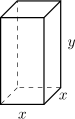
xmhintAs dimensões que resultam na ”menor
quantidade de material” para as cinco faces são as dimensões que resultam na
”menor área de superfície”. Portanto, a quantidade que precisamos ”minimizar” é a
área de superfície, \(S\).
xmhintPrecisamos ”minimizar” a área de superfície,
\(S\).
\(S=x^2 +4xy\)
Lembre-se: sem tampa!
xmhintEm seguida, expressamos \(S\) como função de, digamos, \(x\).
Para isso, precisamos expressar \(y\) em termos de \(x\).
Sabemos que \(V=100\). Portanto,
\(x^2\cdot \class{xm-answer}{\cssId{xm-answer-1}{\phantom{\rule{7em}{1.5em}}}}=100\), e
\(y=\frac {100}{\class{xm-answer}{\cssId{xm-answer-2}{\phantom{\rule{7em}{1.5em}}}}}\).
Segue que
\(S(x)=x^2 +\frac {400}{\class{xm-answer}{\cssId{xm-answer-3}{\phantom{\rule{7em}{1.5em}}}}}\).
xmhintPortanto, precisamos encontrar o mínimo (absoluto) de \(S\) em seu domínio, \((0,\class{xm-answer}{\cssId{xm-answer-4}{\phantom{\rule{7em}{1.5em}}}})\).
Precisamos encontrar os pontos críticos de \(S\). Para isso, precisamos calcular
\(S'(x)\).
xmhint\(S'(x)=2x-\frac {400}{\class{xm-answer}{\cssId{xm-answer-5}{\phantom{\rule{7em}{1.5em}}}}}\).
xmhintPrecisamos encontrar os pontos críticos de \(S\). Portanto, precisamos
resolver a equação
\(2x-\frac {400}{\class{xm-answer}{\cssId{xm-answer-6}{\phantom{\rule{7em}{1.5em}}}}}=0\).
Segue que \(S\) tem um único ponto crítico, \(x=\class{xm-answer}{\cssId{xm-answer-7}{\phantom{\rule{7em}{1.5em}}}}\).
xmhintComo
\(S'(x)=2x-\frac {400}{x^{2}}=\frac {2(x^{3}-200)}{x^{2}}\), segue que
\(S'(x)<0\) em \((0, 200^{\frac {1}{3}})\) e que \(S'(x)>0\) em \((200^{\frac {1}{3}},\infty )\).
Isso significa que \(S\) é decrescente em \((0, 200^{\frac {1}{3}})\) e crescente em \((200^{\frac {1}{3}},\infty )\). Ou seja, a função \(S\) tem tanto um
mínimo local quanto um mínimo absoluto em \(x=c\).
Portanto, as dimensões que minimizam a área de superfície são
\[ \text {largura}=\class{xm-answer}{\cssId{xm-answer-8}{\phantom{\rule{7em}{1.5em}}}},\qquad \text {comprimento}=\class{xm-answer}{\cssId{xm-answer-9}{\phantom{\rule{7em}{1.5em}}}},\qquad \text {altura}=\class{xm-answer}{\cssId{xm-answer-10}{\phantom{\rule{7em}{1.5em}}}} \]